Working Principle Overview A flake ice machine operates through a closed refrigeration cycle + water film ice-making + rotary ice scraping system. It continuously produces dry, thin and uniform flake ice with high efficiency, consisting of three core processes: refrigeration circulation, water film freezing and rotary ice breaking, and water recycling.
1. Closed Refrigeration Cycle (Core Cooling System) The compressor compresses the refrigerant into high-temperature and high-pressure gas. After heat dissipation by the condenser (air-cooled/water-cooled), it turns into high-pressure liquid. The liquid refrigerant passes through the expansion valve for throttling and pressure reduction, forming low-temperature and low-pressure liquid. It evaporates and absorbs heat rapidly in the evaporator, lowering the cylinder wall temperature to below zero, providing continuous low-temperature conditions for ice making.
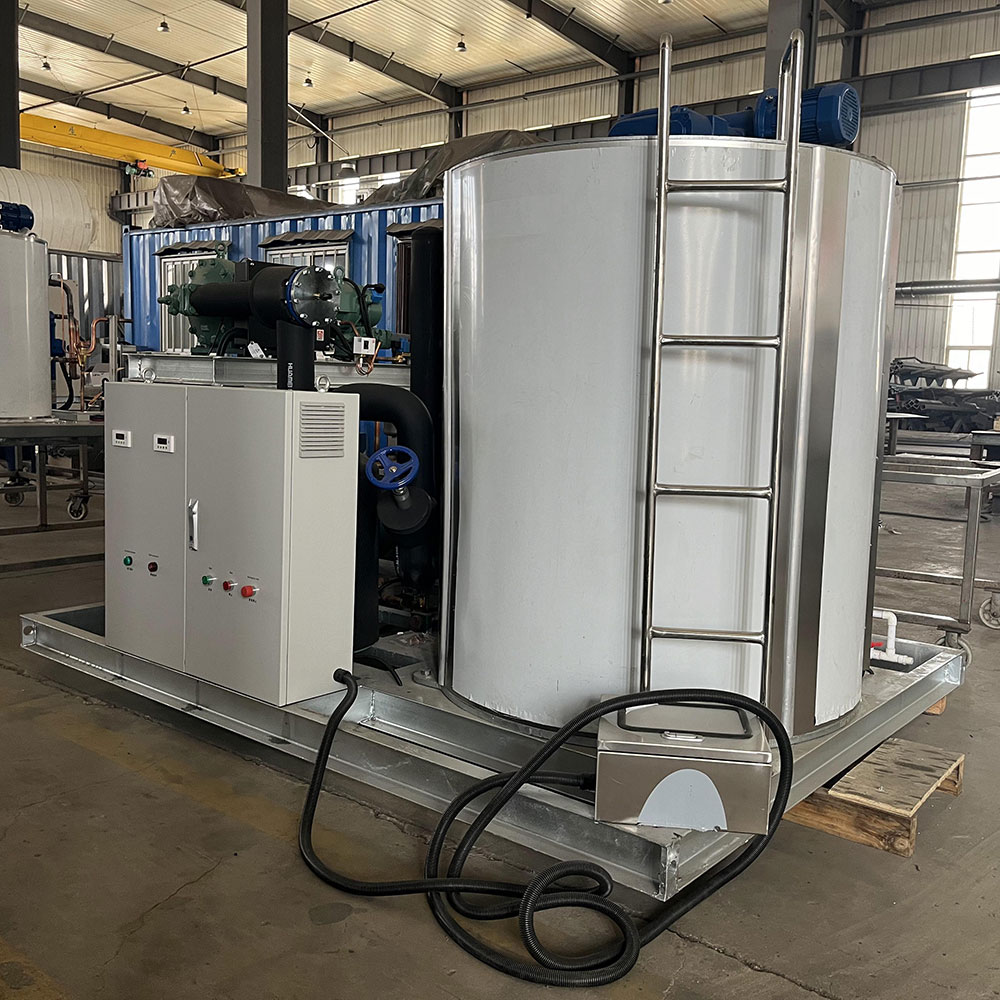
2. Water Film Freezing & Rotary Ice Scraping (Ice Forming Process) The water pump delivers water to the water distribution tray, which evenly sprays a thin water film on the inner wall of the vertical evaporator cylinder. The water film exchanges heat with the low-temperature cylinder wall and quickly freezes into a uniform thin ice layer. The reducer drives the spindle and ice cutter to rotate slowly; the ice blade squeezes and peels the thin ice layer to form irregular dry flake ice, which falls into the ice storage bin through the ice outlet.
3. Circulating Water System The unfrozen excess water flows back to the water tank through the return tank. After filtration and temperature stabilization, it is pumped again for cyclic ice making, avoiding water waste and ensuring continuous and stable ice production.